
A Complete Guide to Exploring the Royal Bengal Tiger’s Mangrove Habitat
The Sundarbans Tiger Safari is a unique type of wildlife destination in South Asia for several reasons. This area is located in the Bay of Bengal delta and is formed by the Ganges, Brahmaputra and Meghna rivers is recognized as one of the main homes of Royal Bengal Tiger.
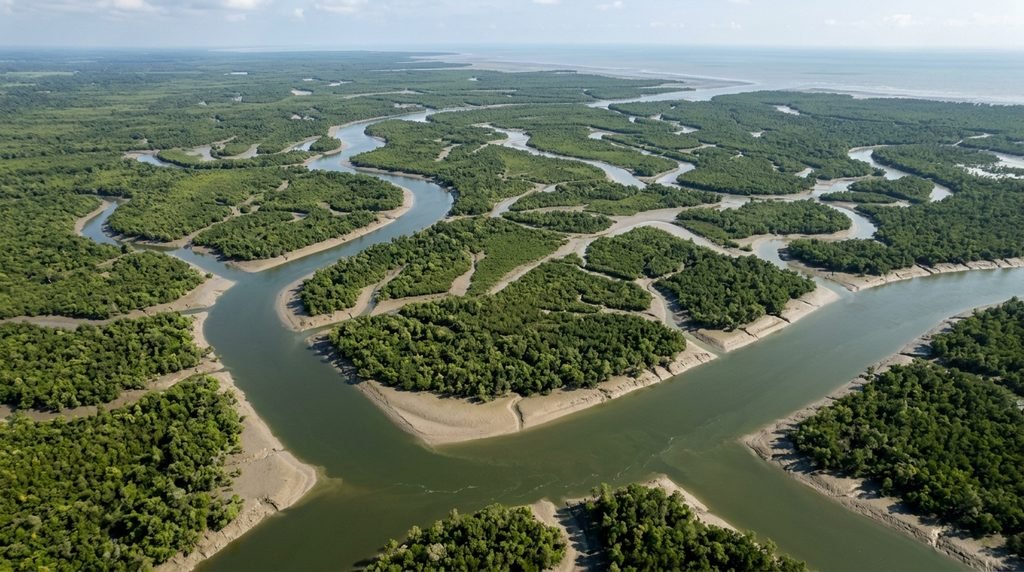
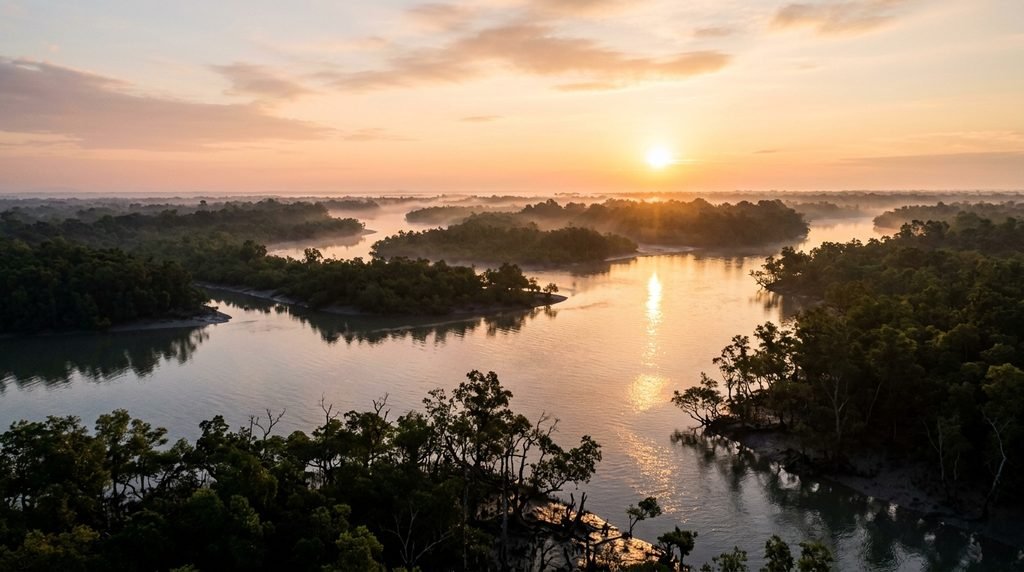
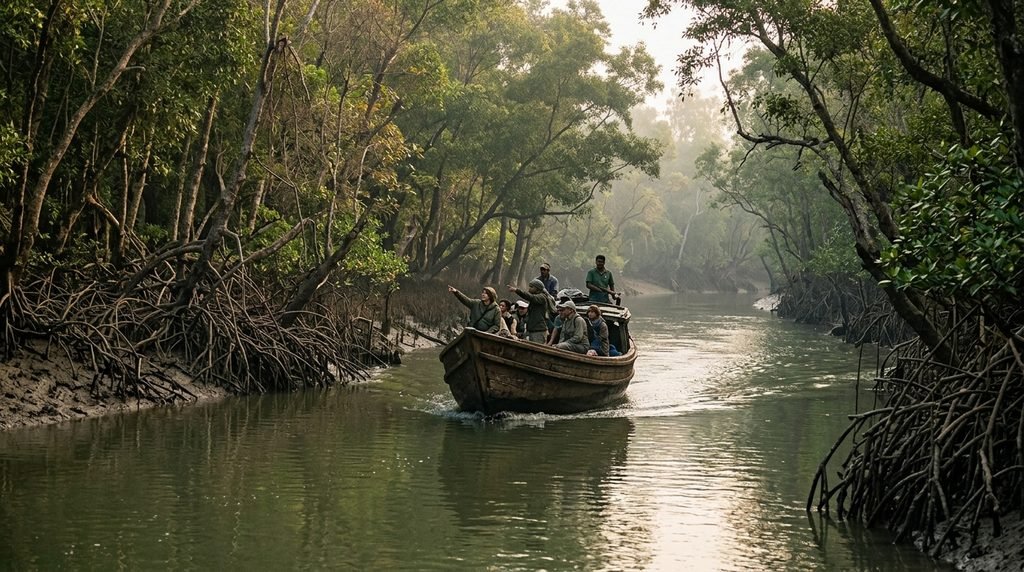
A Sundarbans Tiger Safari is an opportunity to travel by boat on this magnificent natural playground characterized by the presence of waterways, including tidal rivers and channels as well as flat areas along with islands with mangrove forests.
The following guide sends light on the features of the Sundarbans, the most favorable season for going there, what to see on safari and important safety rules as well as information about the wildlife you will see there and some conservation measures undertaken to protect the region.
What Makes the Sundarbans Special?
The Sundarbans are located in the delta formed by three main rivers—the Ganges, Brahmaputra and Meghna—and UNESCO has designated it as a World Heritage Site. UNESCO claims the Sundarbans of Bangladesh is the largest mangrove forest in the world, spreading across nearly 140,000 hectares.
The forest is constantly being modified by tides, floods, sedimentation and erosion. Unlike road networks that run deep into a forest, the Sundarbans are explored mainly via waterways.
Thus, a Sundarbans tiger safari differs from an ordinary jeep safari in nature.
Here, the boat is the principal means of transport. The tourists sail on the boat along narrow and large waterways and the guides look out for wildlife at the banks, mudflats and forest edges.
UNESCO further states that the Sundarbans are an important habitat for the Royal Bengal tiger, estuarine crocodile, Gangetic and Irrawaddy dolphins, river terrapin and many species of birds.
Sundarbans at a Glance
| Feature | Information |
| Location | Southwestern Bangladesh and eastern India |
| Ecosystem | Tidal mangrove forest |
| UNESCO status | World Heritage Site |
| Major rivers | Ganges, Brahmaputra and Meghna |
| Famous wildlife | Royal Bengal Tiger, spotted deer, crocodile, birds |
| Main safari method | Boat and canal cruising |
| Key attractions | Karamjal, Harbaria, Katka, Kochikhali, Hiron Point and others |
| Best general travel period | Cooler, drier months are generally more comfortable |
Why a Sundarbans Tiger Safari Is Different
People normally think of the habitats of tigers to be dry forests, grasslands, and open savannas, but the Sundarbans ecosystem is quite different.
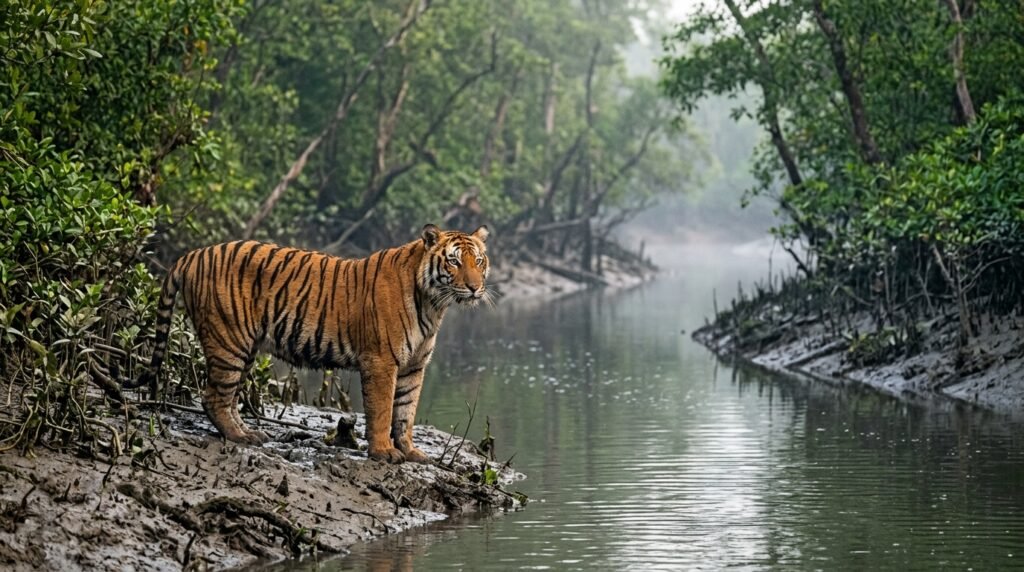
The Royal Bengal Tigers may be found in the landscape full of salt-resistant mangrove vegetation, tidal waterways, and muddy riverbanks. The tigers thus adapt to live in environments where water forms an integral part of the landscape.
During the Sundarbans Tiger Safari, visitors may spend hours cruising along rivers to spot the tigers. Given the dense forest, the limited visibility in the locality, and varying degrees of wildlife movement, this is expected.
Dealing with such uncertainty is part of the process.
Rather than traversing instantly recognizable trails, visitors and guides must use their wits to make the most of opportunities arising in the ecosystem. Something moving on a distant bank or an alarm from a spotted deer or sudden bird activity may get them going.
The Royal Bengal Tiger of the Sundarbans
The Royal Bengal Tiger has been linked to Sundarbans. UNESCO considers this mangrove ecosystem as the core habitat for the species and states that it has managed to adapt to a highly aquatic environment.
Surveys have also been conducted in the Bangladeshi part of the Sundarbans involving camera traps and other methods. A UNESCO conservation report mentioned that in the course of one evaluation conducted in the Bangladeshi Sundarbans the number of tigers was estimated at 114 and provided some insights about the tiger population.
Interpreting these numbers from the point of view of encountering a tiger will not be the right decision as the fact of estimating tiger population should be understood separately from the fact of spotting an individual tiger in the wild.
The most important thing for tourists is to remember that tiger is a wild animal which lives in a complicated ecosystem.
That is why, the Sundarbans tiger safari should never be advertised as guaranteeing the sighting of tigers in the wild.
What Wildlife Can You See?
Despite the fact that tigers are known as the main attraction of Sundarbans, other diverse groups of wild animals also inhabit this area.
During Sundarbans Tiger Safari one can observe:
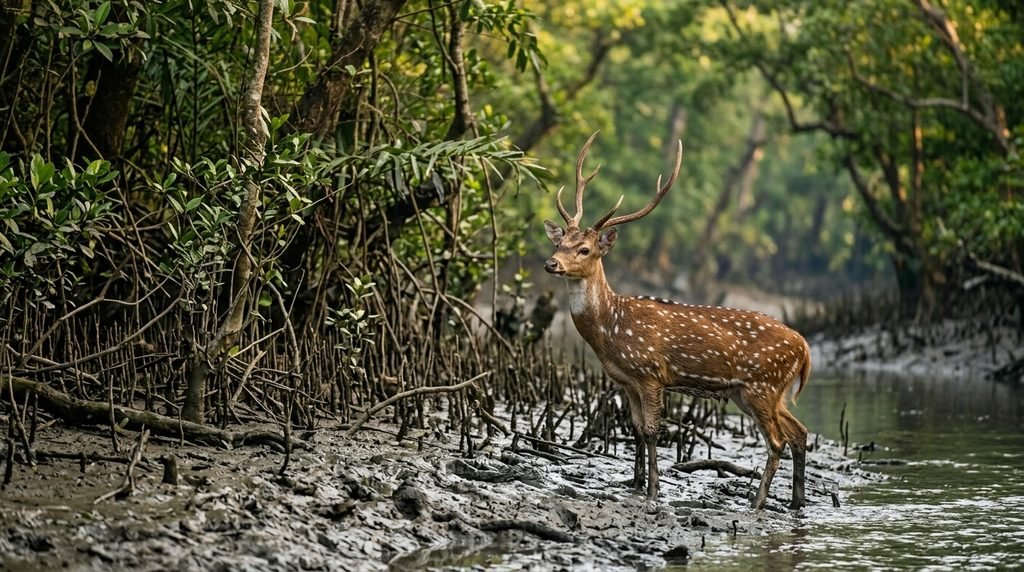
- Spotted deer
- Wild boar
- Rhesus macaques
- Saltwater crocodiles
- Water monitor lizards
- Kingfishers
- White-bellied sea eagles
- As well as other avian and terrestrial animals
UNESCO mentions that Sundarbans is home to a great number of animal species including mammals, reptiles, amphibians, fish, crustaceans, and birds.
Those who are fond of bird watching will have an excellent opportunity to enjoy their passion while traveling along the rivers. The unique combination of mudflats, creeks, and mangrove vegetation allow establishing homes for a number of species.
In addition to that, photographers can find many interesting shots even without many animals hides from their cameras.
Best Time for a Sundarbans Tiger Safari
Choosing the right season can make a significant difference to the comfort of your trip.
The cooler months from approximately November to February are generally more comfortable for exploring Bangladesh’s Sundarbans. Temperatures are lower than during the hottest months, and conditions are often more suitable for extended time on the water.
A Sundarbans Tiger Safari is influenced by more than just the calendar, however. Tide levels, weather and water conditions can affect where boats can travel and what wildlife may be visible.
| Period | General Conditions | Safari Consideration |
| November–February | Cooler and generally drier | Comfortable for extended boat travel |
| March–May | Warmer and increasingly humid | Prepare for heat |
| June–September | Monsoon influence and heavier rainfall | Weather and water conditions can affect travel |
| October | Transition period | Conditions vary |
Instead of planning only around tiger sightings, travelers should consider the entire ecosystem and the practical conditions of boat travel.
What Happens During a Sundarbans Tiger Safari?
In most cases, the journey starts in a hub such as Khulna or other authorized entry points in relation to the itinerary. After the necessary formalities, travelers proceed by boat into the forest.
This officially operated system provides details like sightseeing information, ticketing and registered vessels. Some of the destinations mentioned are Karamjal, Harbaria, Katka, Kochikhali, Dublarchar, Hiron Point and Kalagachhia.
When getting into the forest, the boat passes through canals of the tidal system.
A day in the forest can typically include:
- Early morning wildlife watching.
- Cruising along the channels of the mangroves.
- Stops at certain tourism destinations or viewpoints.
- Wildlife observation either from the boat or some selected locations.
- Resting during the hottest time of the day.
- Watching wildlife in the afternoon.
Important Sundarbans Safari Destinations
The Sundarbans of Bangladesh has its own share of tourism and wildlife sites.
The first tourism site is Karamjal.Karamjal is a popular site for forest interpretation and wildlife viewing.Harbaria is another one of the popular spots in Sundarbans.Harbaria has great opportunities for observing wildlife in the mangrove forest.
Katka is known for its wildlife tourism and is part of many Sundarbans tour itineraries. Kochikhali is another well-known site for wildlife tourism, especially for its natural habitat and opportunities for watching deer and other animals.
Hiron Point is another spot which is included in the various safari tours of the Sundarbans and is popular for wildlife viewing.
The eco-tourism website of the Forest Department provides current information about tourism sites and arrangements for tourists.
Safety Rules You Should Know
Sundarbans is a dynamic and untamed area, which is why safety is an integral part of any excursion here.
The forest department in Bangladesh insists on meticulous adherence to specific measures and rules of conduct within the woods. It is also suggested that tourists do not bathe in the waterways of the forest, spend the night there without permission, or go exploring on their own.
When on a Sundarbans Tiger Safari, tourists must:
- Obey the instructions of forest skippers and rangers.
- Stay in designated areas.
- Put on a buoyancy aid when asked to.
- Never swim or wash in the waters of the forest.
- Never feed animals.
- Keep quiet.
- Refrain from littering the woods or waterways.
- Do not try to attract or approach any animals.
- Be mindful of the route and follow the schedule.
Tides should also be considered. what seems to be navigable at a particular moment may change significantly with the changes in the level of the tide.
This is the reason why using professional crews and reliable tour operators is really necessary.
How to Choose a Responsible Safari Operator
A responsible tour operator must prioritize safety, ensuring that their customers follow all laws and regulations that protect the environment as well as wildlife while enjoying various encounters with different species.
Before booking your Sundarbans Tiger Safari, you should check whether the tour operator:
- Is using officially registered vessels.
- Is completing all the necessary steps to obtain all the approvals from the forest authority.
- Is offering proper safety gear to ensure customers’ comfort.
- Works with experienced guides and personnel.
- Follows the established routes for its vehicles.
- Follows other reasonable practices related to the size of groups.
- Avoids disturbing wildlife populations.
Any tourist can find out which operators and vessels are officially registered using the eco-tourism service of the Forest Department.
What Should You Pack?
If you are participating in a Sundarbans Tiger Safari, you should spend a lot of time outdoors and on water. Therefore, make sure to pack comfortably and practically when making your packing list.
Here is a list of items suggested for your packing list:
- Lightweight and breathable clothing
- Long-sleeved tops
- Comfortable trousers
- Sun protection items
- Sunglasses
- Sun cream
- Anti-mosquito products
- Binoculars
- Camera and lenses
- Water-resistant bag for your electronics
- Reusable water bottle
- Personal medications
- Comfortable shoes
- Waterproof cover depending on the weather
- Clothes with neutral colors can be very useful in wildlife photography.
Photography Tips for the Sundarbans
Photography in the Sundarbans is a painstaking process. The thick trees make it possible for animals to be seen mainly for short bursts of time. It’s much better to use a telephoto lens as opposed to a wide-angle lens in photography for wildlife.
Always have your camera at hand when navigating around river bends, mudflats, and areas where animals can be spotted.
Most importantly, never go close to animals just to capture a good photograph.
The aim is to observe animals respectfully without exerting any disturbance.
Conservation and Responsible Tourism
The Sundarbans is under stress due to climate change and cyclones, habitat loss, poaching and other human activities.
Conservation methods are being developed based on scientific monitoring strategies, such as camera trapping, and community-based approaches.
One of the advantages of the Forest Department’s eco-tourism program is that it creates awareness of the role of tourism in the conservation process.
UNESCO recognizes the Sundarbans for rich ecological processes and biodiversity and underlines the importance of protecting this ecosystem.
Responsible tourism is of great importance.
When tourists collaborate with responsible operators, follow the rules of the forest, and do not harm the environment, tourism appears to be a useful tool of conservation.
Frequently Asked Questions
Will I always be able to see a tiger during a Sundarbans Tiger Safari?
Not at all. Being wild animals, tigers cannot be expected to be seen in their natural environment easily. Dense mangrove vegetation, tidal region and the natural behavior of tigers make tiger sighting a challenging task.
How long should I spend in Sundarbans?
A multi-day trip would make sense for wildlife enthusiasts since it allows exploring the different waterways and seeing the change of terrain from one moment to another.
Am I allowed to walk freely within the territory of Sundarbans?
Not really. Tourists have to follow rules set by the authorities of the State Forest Department and tour organizers. Making your way inside is absolutely forbidden.
Is Sundarbans a good place for photography?
Definitely. The location allows photographers to take photos of animals in some remote areas as well as that of birds. Using a zoom lens and binoculars is very advisable.
What is the most favorable season for visiting Sundarbans?
The best time to go is during the cool season (November through February) when weather conditions allow for comfortable traversing of the area.
Why Choose BD Expeditions?
The visit to Sundarbans is beyond riding the boat. The experience depends on preparation, relevant knowledge about the area, time, safety, and the attitude towards the nature reserve.
BD Expeditions is able to promote its Sundarbans Tiger Safari as the responsible exploration with local guides and achievable wildlife expectations.
The aim is to take people not just to see tigers, but also through the unique mangrove ecosystem and experience its wildlife and nature properly.

Wrapping Up
People interested in discovering wildlife consider a Sundarbans Tiger Safari as a unique opportunity. Travelers might be eager to see the Royal Bengal Tiger, yet they should not forget that an adventure goes beyond observing one animal.
The movement of a boat in narrow creeks, the sight of spotted deers near the jungle, the shape of a crocodile on the mud bank, the singing of a kingfisher are all just a small part of the journey.
In the Sundarbans, animals are not waiting for tourists, the network of rivers is unpredictable, and patience is the key to success.
If travelers are optimistic about their experiences and follow all ecological standards, they will find that a Sundarbans Tiger Safari will prove to be a memorable adventure in Bangladesh.
With BD Expeditions, the journey is about not just searching for the tiger, it is about finding out the ecosystem that provides for the living of the Royal Bengal Tiger in the unusual environment.